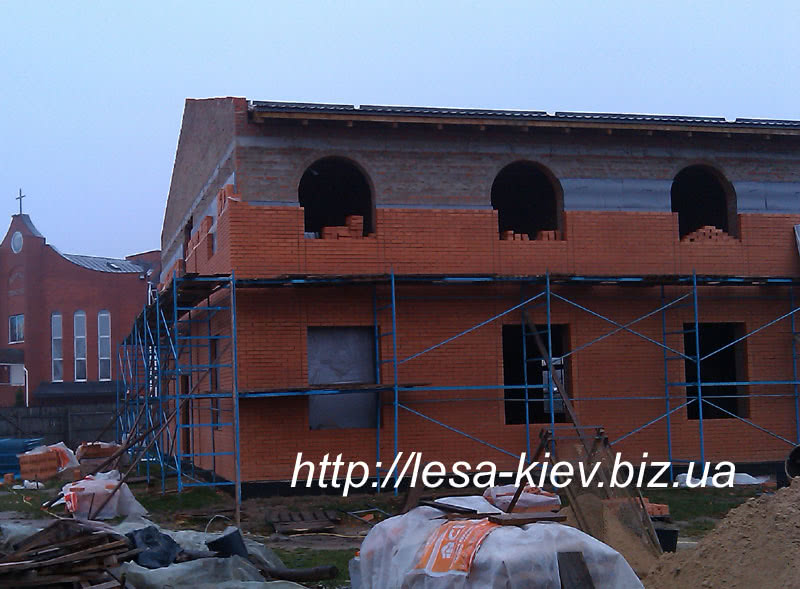
Use of facade scaffolding for masonry
We will look for the answer in the appointment.
| Features \ Scaffold type | Masonry | Painting |
| Purpose | Brick laying, foam blocks, stone, can withstand heavy loads some of them can be put even a pallet of bricks | Front works: warming by polyfoam, plaster walls, painting, decorative works, roofing, gable filing |
| Weight | Heavy: made of thick-walled metal from 3mm and even 5mm, sometimes even very heavy. | Lightweight metal thickness 2mm (or even 1.5mm). Lightweight, not designed for heavy loads. |
| Step height | 0.5 m | 2 m |
| Flooring, work area | Only the top - one level area | With a height of 8m and more - at least 2 platforms: working and safety or all flooring platforms |
| Assembly complexity | longer using like minimum hammer for driving rigs or wedge clamps | simple, fast, without keys and tools, flag locks |
The main difference in the step height and the permissible loads on the site. Let's say so, if we do not load the scaffolds by folding a large number of bricks, foam blocks, stone, we don’t put pallets, then it is necessary to reduce the height step, because laying brick at a distance of chin will not be convenient at all.
Let us now consider the design features of the proposed frame scaffolds:
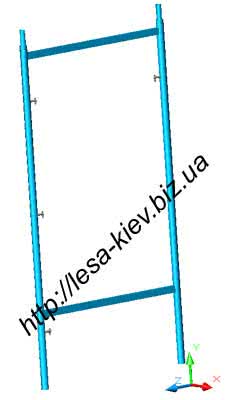 |  |
| Rack pass. Height 2m. Designed to lift people to the desired height (tier). Metal 2mm. | Rack with stairs. Height 2m. Designed for the passage of people on one tier. Metal wall thickness 2mm. |
In the rack-stairs - four horizontal lintels, and in the pass rack - two lintels.
If on the last tier we use rack-stairs instead of walk-through racks, those jumpers in the rack that make up the ladder for raising workers can be used to form an intermediate height with a step of 0.5 m. On these jumpers and you will need to wear the flooring bolts. Since the thickness of the metal in all of our elements is 2 mm, and not 1.5 mm as in other manufacturers, then it is possible to use it for masonry if it is not strongly loaded.
Pros:
We get scaffolding in increments of height - 0.5 m, but it is much lighter in weight: you can quickly assemble and disassemble, rearrange. With a larger volume, the plus is that they will not need vehicles with a large carrying capacity for transportation and delivery to the object, less collateral value than that of transom.
Minuses:
You can not overload, put a pallet of bricks, foam blocks, etc. Those. do not create large loads on facade scaffolding. And also it will not be possible to warm up before work, because Racks are much lighter than special-purpose masonry scaffolding.
Result:
If you work and be friends with your head, you can apply. (Although some of them just want latching scaffolding specially designed for masonry, it is possible that later you would also call the crane to the object to lift the pallets, so that it would be faster. Although, when compared with wedge-clamp scaffolds, the latter are easier to install on large slope).
See how our other customers do it, and their results ...
Please note to the use of racks-stairs (4 lintels). And look at how and where workers fold bricks and foam blocks.
And gentlemen, look and draw your own conclusions ...